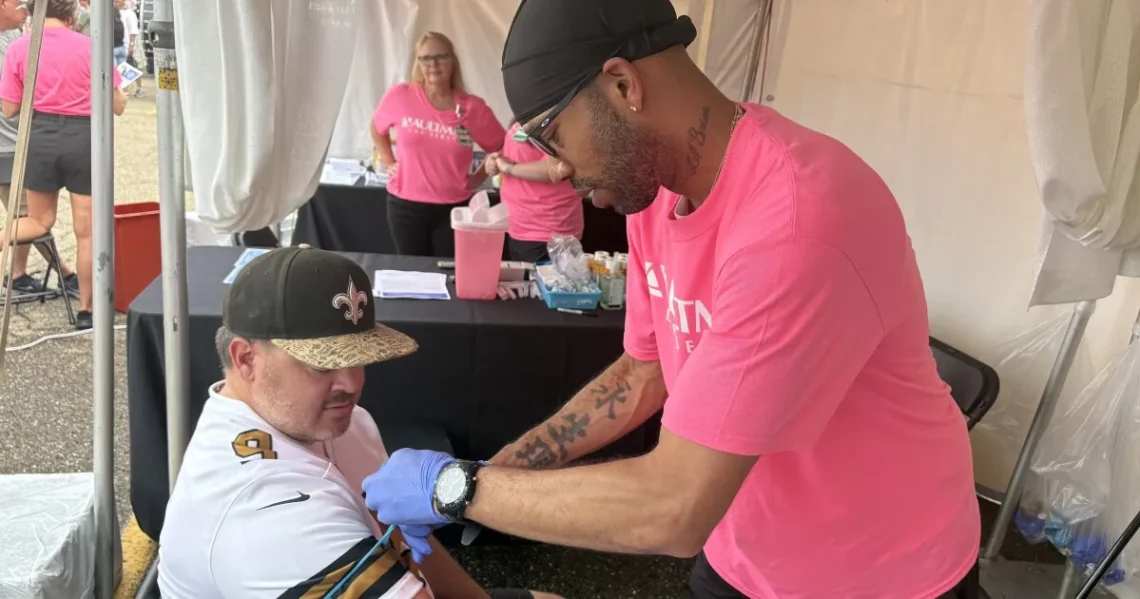
CANTON, OH — Fans visiting the Pro Football Hall of Fame got a chance to take care of something practical while enjoying the festivities: free blood draws to screen for prostate cancer and heart disease. The event, called “Own Your Health,” was set up outside the Hall in Canton and was designed to make preventive testing feel quick and easy.
Organizers said the blood draw took less than two minutes, and participants will receive their results by mail. The screening was open during Hall of Fame festivities, giving visitors a no-cost way to check two major health risks without first going to a doctor’s office.
What The Screenings Offered
The event provided free blood draws aimed at screening for prostate cancer and heart disease. According to the report, the process was fast enough that people were in and out in less than two minutes.
Women also took part in the heart disease screenings. The article did not list any age rules, insurance requirements, ID checks, or appointment steps, so readers should confirm those details directly with the organizers before going anywhere for a similar service.
Participants were told their test results would be sent later by mail. That means anyone who took part did not leave with an on-the-spot diagnosis, but with a follow-up result to watch for after the event.
Why The Event Matters
The screening was framed around two major health concerns. The story noted that heart disease remains a leading cause of death in the United States, and that prostate cancer affects many men over a lifetime.
People who took part said family history and prevention were big reasons to get checked. One participant described strong heart disease history in his family, while former NFL safety Adrian Wilson said he wanted to lead by example and help bring awareness to health risks that can affect Black men at higher rates.
Health workers at the event stressed that knowing your numbers early can matter. Their message was simple: catching a problem sooner gives doctors more options if treatment is needed.
How To Get Involved
The article did not name a public sign-up link, phone number, or mailing address for a next event, so readers interested in similar screenings should check directly with the Pro Football Hall of Fame and Aultman Health System before making plans.
If another screening like this is announced, those are the organizations named in the report as the ones connected to the effort. Anyone thinking about attending should verify the time, location, and any participation rules ahead of time, since those details were not provided in the story.
For people hoping to support a community health day, the model is straightforward: team up with a trusted venue, keep the test quick, and make the service easy to access during an event people are already attending.
A Simple Community Model
This kind of outreach works because it meets people where they already are. A sports event can become a place for prevention, especially when the screening is short, free, and tied to a familiar gathering.
That approach may help reduce the hesitation some people feel about preventive care, especially when they can get tested without a separate trip to a clinic. For neighborhoods elsewhere, the idea could be adapted by pairing health screenings with a local festival, game day, church event, or community fair.
Readers should remember to confirm the details through the named organizations before attending any future screening. The basic lesson from Canton is that a small, visible health check can make prevention easier to take.
What The Screenings Offered
The event provided free blood draws aimed at screening for prostate cancer and heart disease. According to the report, the process was fast enough that people were in and out in less than two minutes.
Women also took part in the heart disease screenings. The article did not list any age rules, insurance requirements, ID checks, or appointment steps, so readers should confirm those details directly with the organizers before going anywhere for a similar service.
Participants were told their test results would be sent later by mail. That means anyone who took part did not leave with an on-the-spot diagnosis, but with a follow-up result to watch for after the event.
Why The Event Matters
The screening was framed around two major health concerns. The story noted that heart disease remains a leading cause of death in the United States, and that prostate cancer affects many men over a lifetime.
People who took part said family history and prevention were big reasons to get checked. One participant described strong heart disease history in his family, while former NFL safety Adrian Wilson said he wanted to lead by example and help bring awareness to health risks that can affect Black men at higher rates.
Health workers at the event stressed that knowing your numbers early can matter. Their message was simple: catching a problem sooner gives doctors more options if treatment is needed.
How To Get Involved
The article did not name a public sign-up link, phone number, or mailing address for a next event, so readers interested in similar screenings should check directly with the Pro Football Hall of Fame and Aultman Health System before making plans.
If another screening like this is announced, those are the organizations named in the report as the ones connected to the effort. Anyone thinking about attending should verify the time, location, and any participation rules ahead of time, since those details were not provided in the story.
For people hoping to support a community health day, the model is straightforward: team up with a trusted venue, keep the test quick, and make the service easy to access during an event people are already attending.
A Simple Community Model
This kind of outreach works because it meets people where they already are. A sports event can become a place for prevention, especially when the screening is short, free, and tied to a familiar gathering.
That approach may help reduce the hesitation some people feel about preventive care, especially when they can get tested without a separate trip to a clinic. For neighborhoods elsewhere, the idea could be adapted by pairing health screenings with a local festival, game day, church event, or community fair.
Readers should remember to confirm the details through the named organizations before attending any future screening. The basic lesson from Canton is that a small, visible health check can make prevention easier to take.
Something happening in your area? The Native Voice wants to hear about it.